
Should You Sell Shares in Your Company's Tender Offer?

Updated: May 13
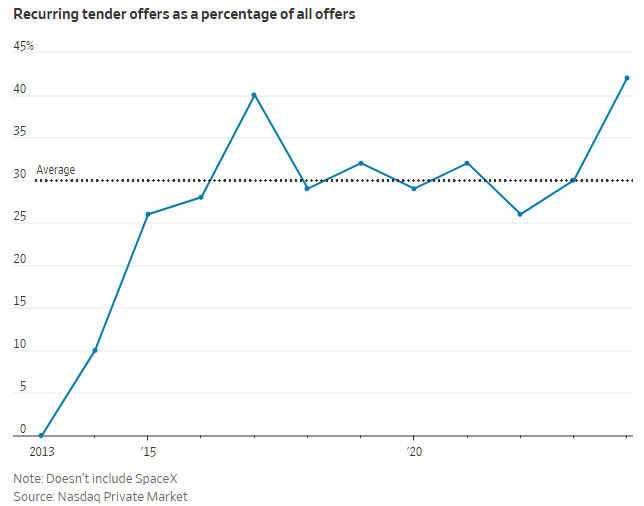
As growth companies stay private for longer, the tender offer has risen to fill the void left by the delayed IPO. Some larger private companies, such as fintech player Stripe and software giant Databricks, have even moved to provide recurring tender offers to employees as the big liquidity event remains on the backburner. In order to make informed decisions, employees must understand how a tender offer works, how they will be taxed on share sales, what should drive their decision making, and how best to improve diversification with the proceeds.
Contents:
What is a tender offer and how do they work?
How should you decide on selling a portion of your shares?
How do investment outcomes differ between a diversified stock exposure and young technology companies?
What types of investments can offer diversification to a large position in your company stock?
How can 1620 IA help you prepare for and participate in a future tender offer?
What is a Tender Offer?
A tender offer occurs when a third-party investor, or the company itself, offers to purchase equity from existing shareholders at a predetermined price. In this case, we are focused on employee shareholders. In the absence of an IPO, or other large liquidity event, a tender offer can provide a substantial benefit to long-time employees with much of their net worth tied up in illiquid private stock.
How Does a Tender Offer Work?
Typically, a tender offer allows employees to sell up to a maximum percentage of their vested equity. Depending on the form of this equity (vested options, vested shares, exercised shares), there will be different tax impacts on the sale. For example, the sale of vested options will incur ordinary income taxes by calculating the difference between the exercise price (price at which you can buy the shares) and the sale price for the options being exercised and sold. For restricted stock units (RSUs) or exercised shares, the tax impact will depend on the holding period since the shares vested or were exercised. To reach long-term capital gains treatment, RSUs must be held for 1+ years from vesting and exercised options must be held for 1+ years from exercise and 2+ years from grant date.

Should you tender a portion of your shares?
This decision is a very personal one and should not be dictated by what your peers are doing. The key factors to consider include (1) your current savings and liquid investments, (2) any potential cash needs to meet financial goals over the next few years, and (3) the concentration of your net worth in your company shares. Employees may wish to use proceeds from a tender offer to fund a big purchase such as a down payment on a first home. If an employee does not have many pressing financial goals to fund, it is best to consider what percentage of the employee’s net worth is concentrated in their company shares. If the percentage is very high, say above 30%, a tender offer may be an opportune moment to increase your diversification, liquidity, and flexibility. The target concentration level should consider an individual’s risk tolerance, savings/spending rate, ongoing equity awards, required return to meet financial goals, and value of other investment assets.
Investment Outcomes: Young Tech Companies vs. The Market
For younger, higher growth companies, the distribution of potential outcomes is especially high. Future performance may be stellar or it may be underwhelming – it all depends on the sustainability of growth and the ability to ramp profitability. The other factor to remember is that stock performance can often deviate from the fundamental performance of the business. In high growth companies, expectations can quickly elevate and result in unsustainable valuations. For example, Snowflake was arguably the hottest IPO of 2020 but shares substantially underperformed the overall market from their list price of $120 while revenue has grown nearly 10x. While this example may be exaggerated given SNOW went public at the height of software multiples, I would bet if you had told Snowflake employees revenue would grow 10x from the time of the IPO to 5.5 years later, most would have expected share prices to explode. This type of outcome is not isolated to public markets and can also happen in private markets, as seen by CapitalOne’s recent acquisition of Brex for just over $5B. This price compares to a funding round in 2022 that valued the company at over $12B.

Trimming a large stake can help narrow the distribution of potential future outcomes for your overall investment portfolio. Diversifying can also help guard against risks that may arise such as rising competition, slowing sector growth, or company-specific missteps. The wide range of potential outcomes, and the high risk/high reward nature of high growth private companies, needs to be considered when looking at the concentration of your assets in company stock. The table below shows the 10 largest IPOs from our 2020 cohort and lists descriptive statistics to show how the volatility of single stocks compares to that of the market. Companies that go on to produce stellar returns over long periods of time are the exception, not the rule.

*Data from y-charts and analysis conducted by 1620 IA. Total return includes dividends. IPO sample excludes biotech and financial holding companies (SPACs)
As you can see, individual stocks are orders of magnitude more volatile than the overall market. The median max drawdown (peak to trough decline from highest price to lowest price at any time during the 3-year period) for the stocks in this group reached -48% vs. -19% for the market. In addition, the median share price underperformance vs. the market at any point during this time period was -73%. Lastly, the median standard deviation of monthly returns for these stocks was 15% vs. just 4% for the market. While being private can mask the volatility of share performance due to infrequent pricing, this example serves to show what can happen when that veil is lifted. Employees need to understand that the range of investment outcomes in individual stocks is incredibly wide and diversification helps to not only narrow the range of potential outcomes, but also serves to minimize the risk of a steep decline in your net worth due to factors specific to your company stock.
How to Diversify?
If reinvesting proceeds, the key is to increase diversification while keeping return targets in line with your goals. If keeping a high return target and diversifying a concentrated tech position, diversifying assets might include real estate, international stocks, or strategies tilted towards slower growth/defensive sectors like healthcare and consumer staples. For lower return targets and shorter time horizons, high quality fixed income exposures like investment grade corporate and government bonds can help defend against stock market downturns. Commodity exposure may help guard against spikes in inflation which, in the past, have led to significant valuation multiple contraction in technology stocks (see 2022). The reinvestment decision needs to follow a coherent plan that targets improved diversification while considering the ability, both mathematical and psychological, to tolerate stock-related risk.
How Can 1620 Investment Advisors Help in the Decision-Making Process?
By taking a look at the full financial picture and putting income, assets, debt, and expenses in the context of specific financial goals, we can help individuals make informed decisions with their equity in a rational, tax-efficient manner. For employees with stock options, we work ahead of time to establish a plan for proactive options exercises while managing their exposure to the Alternative Minimum Tax. The goal is to improve after-tax outcomes in future liquidity events, such as tender offers. This planning process incorporates the client’s specific circumstances as well as grant-specific factors such as exercise price vs. FMV, early exercise optionality, and the number of years until grant expiration.


Comments